






Product Description
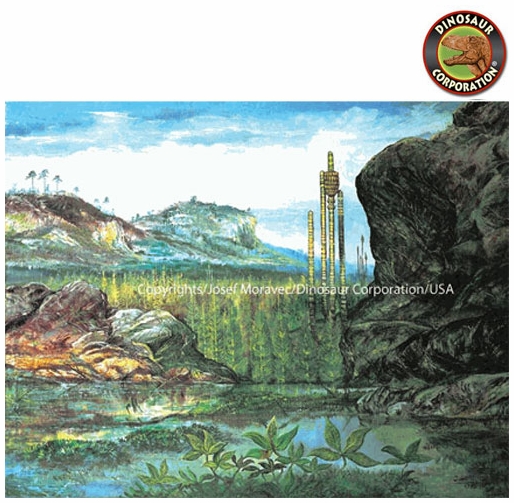
Triassic Period - Triassic Pictures. Printed on premium glossy photo paper.
Original oil painting by Josef Moravec is in the art collection of Dinosaur Corporation.
Note: Watermarks and Copyright markings do not appear on the final photo quality prints.
The Triassic is a geologic period that extends from about 251 to 199 Ma (million years ago). As the first period of the Mesozoic Era, the Triassic follows the Permian and is followed by the Jurassic. Both the start and end of the Triassic are marked by major extinction events. The extinction event that closed the Triassic period has recently been more accurately dated, but as with most older geologic periods, the rock beds that define the start and end are well identified, but the exact dates of the start and end of the period are uncertain by a few million years.
During the Triassic, both marine and continental life show an adaptive radiation beginning from the starkly impoverished biosphere that followed the Permian-Triassic extinction. Corals of the hexacorallia group made their first appearance. The first flowering plants (Angiosperms) may have evolved during the Triassic, as did the first flying vertebrates, the pterosaurs.
The Triassic climate was generally hot and dry, forming typical red bed sandstones and evaporites. There is no evidence of glaciation at or near either pole; in fact, the polar regions were apparently moist and temperate, a climate suitable for reptile-like creatures. Pangaea's large size limited the moderating effect of the global ocean; its continental climate was highly seasonal, with very hot summers and cold winters. It probably had strong, cross-equatorial monsoons
The Triassic period ended with a mass extinction, which was particularly severe in the oceans; the conodonts disappeared, and all the marine reptiles except ichthyosaurs and plesiosaurs. Invertebrates like brachiopods, gastropods, and molluscs were severely affected. In the oceans, 22% of marine families and possibly about half of marine genera went missing, according to University of Chicago paleontologist Jack Sepkoski.
Though the end-Triassic extinction event was not equally devastating everywhere in terrestrial ecosystems, several important clades of Crurotarsi (large archosaurian reptiles previously grouped together as the thecodonts) disappeared, as did most of the large labyrinthodont amphibians, groups of small reptiles, and some synapsids (except for the proto-mammals). Some of the early, primitive dinosaurs also went extinct, but other more adaptive dinosaurs survived to evolve in the Jurassic. Surviving plants that went on to dominate the Mesozoic world included modern conifers and cycadeoids.
It is not certain what caused this Late Triassic extinction, which was accompanied by huge volcanic eruptions about 208-213 million years ago, the largest recorded volcanic event since the planet cooled and stabilized, as the supercontinent Pangaea began to break apart. Other possible causes for the extinction events include global cooling or even a bolide impact, for which an impact crater surrounding Manicouagan Reservoir in Quebec, Canada, has been singled out. At the Manicouagan impact crater, however, recent research has shown that the impact melt within the crater has an age of 214±1 Ma. The date of the Triassic-Jurassic boundary has also been more accurately fixed recently, at 202±1 Ma. Both dates are gaining accuracy by using more accurate forms of radiometric dating, in particular the decay of uranium to lead in zircons formed at the impact. So the evidence suggests the Manicouagan impact preceded the end of the Triassic by approximately 12±2 Ma. Therefore it could not be the immediate cause of the observed mass extinction.