











Camarasaurus supremus & Allosaurus fragilis
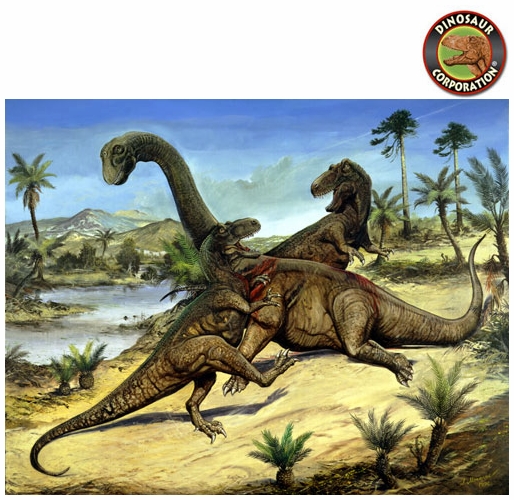 |
Camarasaurus supremus and Allosaurus fragilis. Oil painting by Josef Moravec. 30" x 24".
* Available for sale to museums and serious art collectors.
* Contact us: Dinosaur Corporation
CAMARASAURUS supremus was a large Jurassic sauropod that subsided in moist tropical plains. Camarasaurus had a small head with many spoon shaped teeth that assisted in chewing the tough fibrous plants of that time. With its long neck it could eat the fresher materials at the top of the larger trees and plants. Being a herd animal, the Camarasaurus was constantly bothered by predacious dinosaurs, one of which was the Allosaurus.
TIME - 156 - 145 MYA, Late Jurassic
RANGE - USA (Colorado,Utah,Wyoming)
SIZE - Up to 66ft (20m) long .
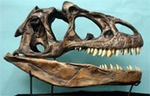
ALLOSAURUS fragilis was the main meat eating dinosaur of the Jurassic and the greatest worry of the herbivorous dinosaurs of its days. Allosaurus probably traveled in small group to assist each other in the attack on a larger animal, such as Apatosaurus. Allosaurus received its name based on some smal finds in 1877 and the first complete skeleton was unearthed in 1883 and 1884.
TIME - 156 - 145 MYA, Late Jurassic period.
RANGE - USA (Colorado,Utah,Wyoming)
SIZE - Up to 36ft (12 m) long.
***
See more Dinosaurs & Prehistoric Ice Age Animals Oil Paintings in Dinosaur ExhibitsContact us to obtain permission for commercial usage of this image: Dinosaur Corporation
© Copyright Dinosaur Corporation, USA. All rights reserved TM
Add Related Items
Recently Viewed Items
 Camarasaurus attacked by Allosauruses. Printed on premium glossy photo paper. Original art by renown paleo-artist Josef Moravec. 8.5" x 11" $20.00 |  Camarasaurus supremus. Allosaurus fragilis. Printed on premium photo quality super "B" paper 13" x 19". Original oil painting by renown paleo-artist Josef Moravec is in the art collection of Dinosaur Corporation. Note: Watermarks and Copyright markings do not appear on the final photo quality prints. $80.00 |
 Dinosaurs! Camarasaurus & Allosaurus. Printed on premium photo quality super "B" paper 17" x 22". $120.00 |  Camarasaurus supremus & Allosaurus fragilis. Jurassic Dinosaurs. Museum quality Photographic art print in 14" x 11" frame, double matted in glass. $90.00 |